Cancer care never stands still, but the data that clinicians rely on can be years and months out of date. Flatiron’s NHS partners receive curated data that is refreshed every three months, giving their clinical teams an up-to-date picture of their patients’ treatment journeys. Dr Kaiser Anam, a Medical Director in the UK team, explains what this means in practice.
Raising the standard of care for patients, and their access to treatments, are core priorities for the NHS. But other existing UK RWD data sources can be 18 to 24 months old by the time it reaches them. In a field of medicine where treatments change quickly, that delay matters.
Flatiron’s unique partnership approach
Flatiron Health UK partners with NHS organisations across the UK to turn routine clinical records into high-quality, research-ready cancer data. Our partnerships include Leeds Teaching Hospitals NHS Trust, University Hospitals of Leicester NHS Trust, Newcastle upon Tyne Hospitals NHS Foundation Trust, and NHS Greater Glasgow and Clyde. These partnerships work in two ways:
-
For our NHS partners: Our team of clinical abstractors curates and quality-assures patient data for our NHS partners in a secure environment, and the curated dataset goes back to the partner for its own clinical teams to use. They use it for audit, service improvement and understanding their local patient population.
-
For wider research: separately, anonymised data is made available for approved research, including by academic researchers and life sciences companies, under strict governance through a trusted research environment. All data access requests are considered and approved by an oversight group that includes patients and lay members. No personal information ever leaves the NHS’ control.
Benefits at a glance
For NHS clinical teams, continuous curation provides:
-
Recent data: refreshed every three months, not a snapshot that’s up to two years old.
-
Information on the whole patient journey: diagnosis, lines of treatment and outcomes, followed over time for each patient.
-
Quality that keeps improving: Flatiron extracts deep clinical insights from complex unstructured data such as notes, pathology reports, and clinical letters. Our longitudinal depth at scale enables oncology practices to make better clinical and operational decisions. Every update is quality-checked by oncology physicians, nurses, and research practitioners, ensuring accuracy and enabling continuous improvement.
-
Less time on audit: trusted, ready-made data for quality-improvement work
-
Earlier insight into new treatments: how recently approved therapies are being used locally, and where the barriers are.
Recent data, not a two-year snapshot
A year in cancer care is a lifetime. Patients may develop new tumours. They might have moved through surgery, chemotherapy and radiotherapy and gone into remission. Or their cancer may have stopped responding to a treatment that was previously working well for them. And new therapies, biomarkers and treatment regimens are emerging all the time. Kaiser is an oncology research physician who previously worked in the NHS, and joined Flatiron last year after working on real-world data projects across the NHS.
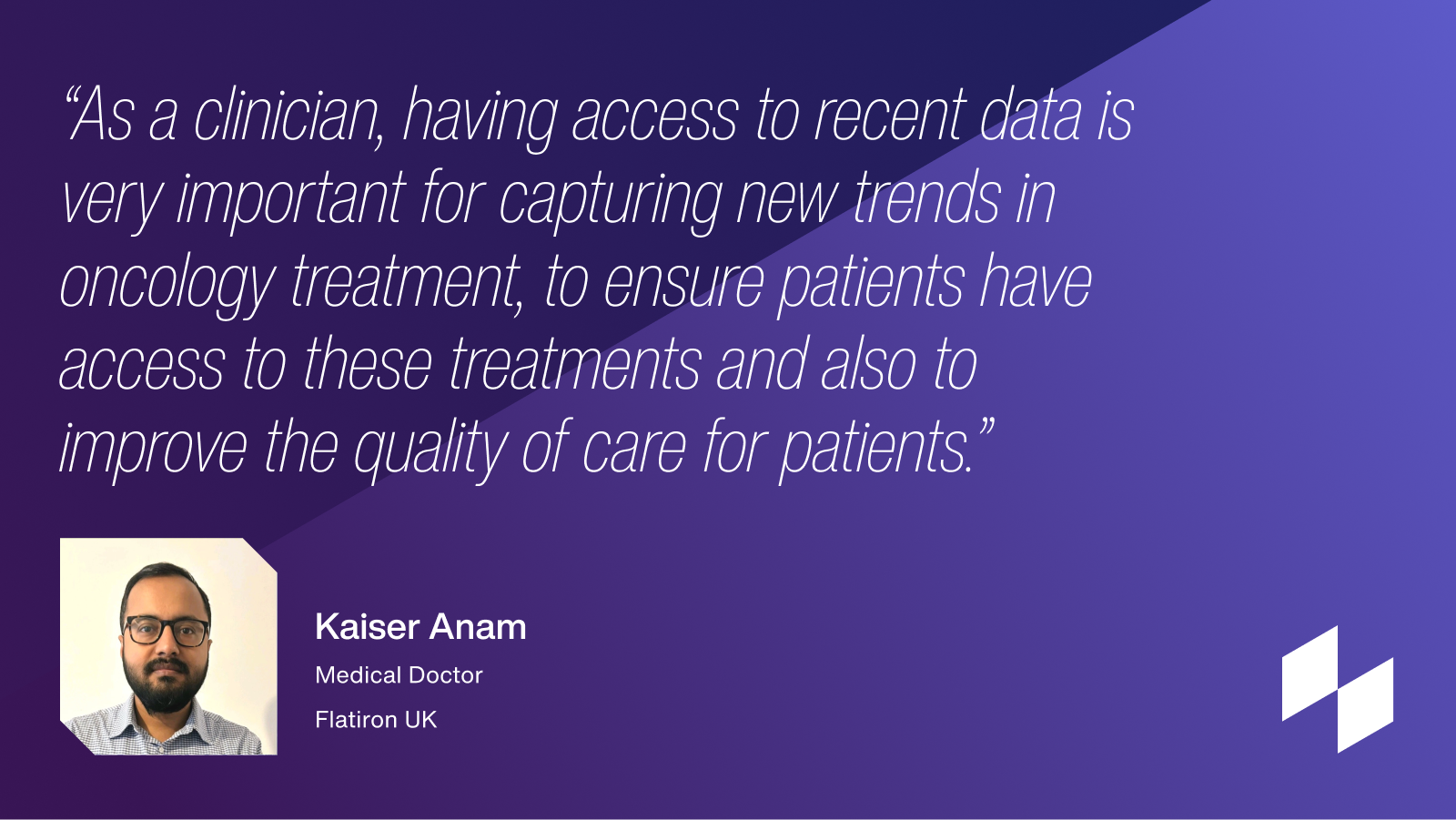
“As a clinician, having access to recent data is very important for capturing new trends in oncology treatment, to ensure patients have access to these treatments and also to improve the quality of care for patients.”
Kaiser joined Flatiron last year, bringing with him a wealth of experience working on real-world data projects in the NHS.
“In settings such as breast cancer or lung cancer, for example, the National Registry data are somewhere between 18 to 24 months old. So if we are hoping to learn more about the uptake of treatments approved over the past two years, this is a challenge.
“Once we have the three-monthly data, we can go in with our clinical team and query it, which isn’t always possible when data is frozen in time from six months to a year ago,” explains Kaiser.
Because each update builds on the last, trusts can track longitudinal patient journeys within their own systems using pseudonymized identifiers, while data shared with Flatiron is fully anonymized to prevent re-identification.”
Quality that improves with every update
Each new batch of data goes through rigorous quality assurance (QA) by Flatiron’s clinical abstractors. QA can also retrospectively help uncover any errors or anomalies in previous tranches of data for patients, improving the overall quality of the entire longitudinal dataset. For clinicians, this means having access to data they can trust.
“This is how Flatiron’s product stands out. Other approaches often capture only specific aspects of a patient’s health or care, such as biomarkers or particular patient outcomes. At Flatiron, we capture the whole patient journey, so that we can work out lines of therapy and track patient outcomes over time,” he explains.
“Other companies will curate a snapshot of data for a given project, frozen in time, and then they'll leave it there. But we maintain our data; it's a live dataset, irrespective of when someone is contracting with us or not. But when they do, they get both live and historical data,” says Kaiser.
Less time on audit, more time with patients
Most NHS trusts and hospitals, including Flatiron’s partners, run internal quality-improvement projects for each cancer type. Twice-yearly audits typically assess patient outcomes and performance against national guidelines for new-treatment uptake, expected outcomes and other clinical benchmarks.
This is another area where Flatiron’s up-to-date health data comes into its own.
“Flatiron’s recent data cuts the admin time for clinicians, because they get ready-made data, which they can trust, which is research-ready and which is quality assured,” says Kaiser.
Speaking from his experience as an NHS clinician, Kaiser describes how this can work in practice.
“Twice per year, I’ll typically spend three to four months looking at electronic health records, trying to understand how we measure up against these national clinical benchmarks. It is an essential part of the job, but it cuts into our time spent on the wards and clinics with patients,” he says.
“From the clinician's perspective, a ready-made dataset that shows these outcomes and uptakes of treatment not only saves time, but it helps NHS clinicians to get a sense of actual patient benefits, and whether there is any local practice, patient access or patient outcomes that can be improved.”
Earlier insights into new treatments
Kaiser cites a recent example of how constant data curation can help clinical teams see how new treatments are being used locally. CDK46 inhibitors, a class of drugs given after breast cancer treatment to reduce the risk of the cancer returning, were initially approved only for patients with a high risk of breast cancer coming back, whose disease had spread to nearby lymph nodes. Later, access was expanded to include select node negative patients, allowing for a broader group of patients to benefit.
"Without being able to review recent data from the past 18 months, it would not be possible to determine how much benefit patients with the expanded treatment approval are getting in real world settings," says Kaiser.
“This is a situation in which we would have insight into a clinician’s decision to offer the treatment and the patient's willingness to take it. We could look at the data to see if there are any barriers to uptake of this treatment in the expanded approval setting, such as toxicities,” Kaiser says.
“With real-world evidence to show that there is an unmet need in NHS treatment, NICE – UK’s independent public body that decides which treatments are safe, effective, and affordable enough for the NHS to fund – could approve a new treatment for use on the NHS if it is deemed safe, effective, and affordable enough for the NHS to fund. So, this is a key example of where our patients will benefit if we have more robust, accurate data,” he adds.
Flatiron’s current, high-quality, longitudinal view of cancer care gives our NHS partners a trusted, up-to-date picture of their patient population. It can reduce the burden of local audits, reveal barriers to treatment uptake and help evaluate new therapies sooner within their own local patient populations. Ultimately, our timely and trusted real-world evidence can support better-informed decisions—giving NHS teams more time for patients and helping more people access effective care. In our next blog we’ll look at how the same data supports wider research.