Flatiron Health UK and its NHS partners are building a national, real-world colorectal cancer dataset and giving clinicians the tools to answer their research questions.
In the UK, colorectal cancer (or bowel cancer as it is more commonly referred to) is the fourth most common cancer and accounts for 12% of all new cancer cases. Over 48,000 people are diagnosed each year, with a higher incidence in men than women. Screening programmes, earlier diagnosis and advances in treatment, have resulted in improved survival rates in recent decades, with more than 50% of patients living longer than 10 years following a diagnosis, compared to only 25% in the 1970s.
The challenge: Inconsistent, fragmented data
Despite these improvements in outcomes, the research and insights that inform better patient care, new treatments and diagnostic approaches are often slowed down by fragmented and inconsistently-curated patient data. Every day, NHS teams generate a wealth of information about how patients with cancer are diagnosed, tested, treated and cared for. Much of this information is stored in electronic health records that are difficult to bring together and compare. This makes it difficult for researchers and clinicians to see how treatment, testing and outcomes vary at a local NHS trust level and at a national scale. Cancer Research UK's 2026 data science strategy pointed to inconsistent curation, rather than an absence of data, as the central barrier to research. This is the insight that informs better patient care, health technology assessments and policy.
At the same time, individual NHS trusts rarely have the data analytics capacity, or the clinical time, to interrogate their own data quickly, for example to determine how many patients might be eligible for an upcoming trial, or to understand patterns of care across a group of patients.
The solution: A dataset built with the NHS
Working in partnership with NHS trusts, Flatiron Health UK has built a national, real-world colorectal cancer dataset designed to meet these needs. It is derived from electronic health records, bringing together structured fields and unstructured sources (including clinician’s notes and pathology reports) through technology-enabled abstraction combined with clinical review. The dataset is refreshed regularly, so it reflects a current picture of care rather than a historical snapshot.
All patient data is anonymised, held under both the national and local data opt-outs, and governed to recognise NHS standards, including Health Research Authority approval, local Caldicott Guardian approval, Cyber Essentials Plus, the Data Security and Protection Toolkit, and aligned with the Five Safes framework.
The following set the national dataset apart from what exists through other data sources:
It’s current.
National registry data can often carry a delay of a few years before it becomes available for analysis, meaning it is challenging to access up to date testing and treatment rates. Flatiron’s dataset is refreshed every three months to show what is happening in care now, not what was happening historically.
Completeness of biomarker data.
Flatiron data captures biomarker testing at a level of completeness that is hard to achieve from structured data alone. The company’s approach to abstraction covers pathology reports and clinician notes where much of this detail actually lives.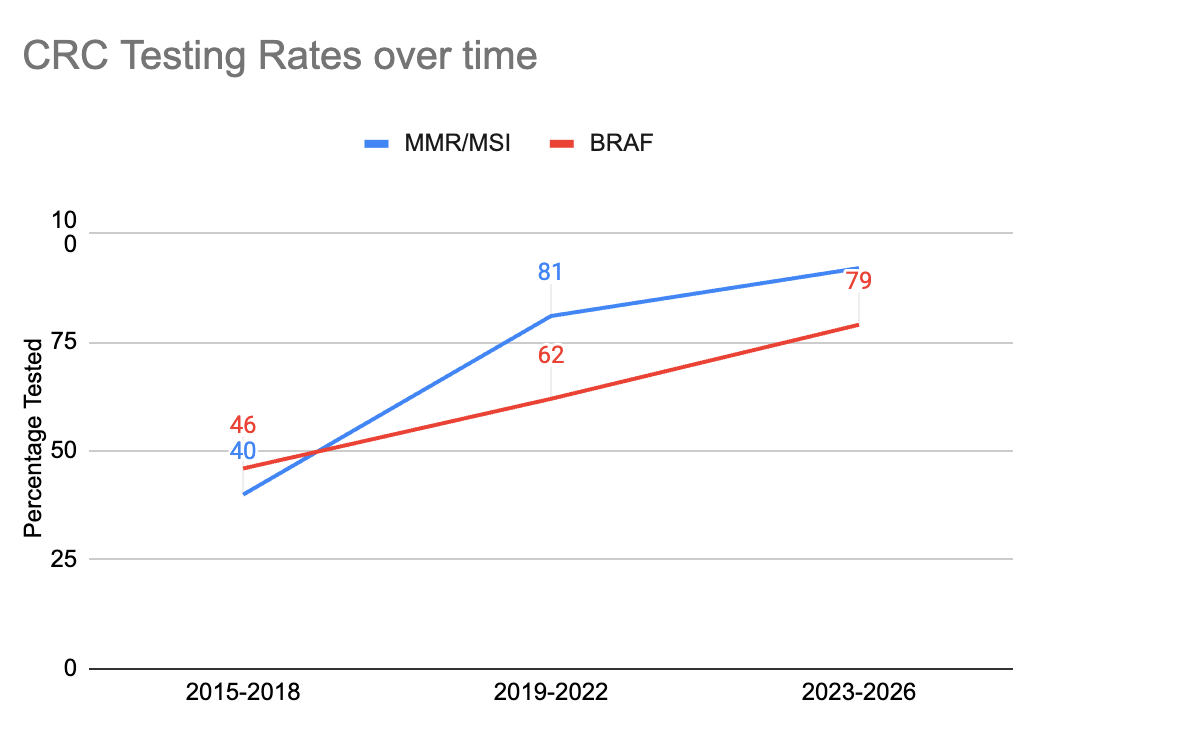
Flatiron national CRC dataset demonstrates increased biomarker testing rates over time
Recently, this depth of data was presented in a poster at the Association of Coloproctology of Great Britain and Ireland (ACPGBI) 2026 conference, characterising real-world testing, treatment patterns, and outcomes, in colorectal cancer across Flatiron’s NHS partnerships.
Three layers of value for a partner trust
For an NHS trust or board, a data partnership with Flatiron Health UK delivers value in three significant ways:
-
Contributing to national evidence. Each partner helps build a cancer dataset that is more comprehensive than any single NHS partner could assemble alone, and can access the non-identifiable dataset within a secure Trusted Research Environment (TRE) to run their own patient-level analyses.
-
Answering your own questions, quickly. Flatiron’s partnerships provide each NHS partner with access to its own data alongside self-service tooling for fast, higher-level insight. That might mean producing a robust estimate of eligible patients for an expression of interest or early-stage trial feasibility assessment. This could include interrogating your own data to surface insights worth a closer look, or benchmarking your testing and treatment patterns against the national picture.
-
Going further, with support. Each NHS partner receives its own curated data within its secure environment for internal analysis if a research question requires deeper investigation. When in-house data science or analytical capacity is limited, Flatiron's research and analytics expertise is available, from education and support to analytical work.
Working in practice at Leeds Teaching Hospitals
Leeds Teaching Hospitals NHS Trust is one of the partner sites where this has come to life. The team accessed data in the Trusted Research Environment to generate estimates for trial expressions of interest. As they explored their site data, they identified clinical patterns that warranted deeper investigation. Subsequent internal investigation highlighted opportunities to improve internal coding and data quality, and surfaced areas where further case-level review could enhance understanding of clinical decision-making. This type of granular insight would previously have required significant manual effort to surface.
Moving forward, Flatiron UK data will be accessed through Flatiron Telescope, our Trusted Research Environment is designed to be useful across a range of roles, including clinicians who want an answer to a research question, and real-world data and informatics teams running more detailed analysis.
Partner with us
A Flatiron partnership is a two-way exchange where NHS organisations contribute to a national evidence base for cancer research, and gain the tools and support to answer their own questions along the way.
If you'd like to talk about what a partnership could look like for your organisation, we'd welcome the conversation. Contact us today.