Introduction
Cancer prevalence in the UK is rising, with more than 1,000 people diagnosed in the UK every day1. Survival rates for cancer are improving, but at the slowest rate in 50 years2, and patients are waiting too long for diagnosis and treatment. At the same time, opportunities to learn from patient experiences are being missed because health data is often fragmented, complex, and difficult to combine and analyse at scale.
Flatiron Health UK is working with partners across the NHS to change this. We safely and securely translate information captured in routine cancer patient care (also known as real-world data) into anonymised, research-ready datasets that can enable improvements in cancer diagnosis, treatment and outcomes. Subject to robust safeguards, these curated datasets are returned to our NHS partners to enable improvements in patient care and new research opportunities for the NHS and its patients. The datasets also form part of Flatiron’s secure global network, advancing international cancer research while ensuring value flows back to the NHS and contributes to the UK economy.
The challenges
UK health data alone isn’t enough
UK health and care organisations generate vast amounts of data across the population of 68 million people. Despite this scale, UK data alone cannot answer every question in health research. To be meaningful, cancer datasets need to be reflective and representative of diverse patient populations and healthcare settings across the world. High-quality data can come from clinical trials, but it is often not representative, as they tend to reflect patients from certain ethnic and socioeconomic backgrounds, which limits their applicability across diverse, global settings. Without breadth and diversity, research insights risk being incomplete and unbalanced. In addition, for rarer types of cancer, the number of patients within the UK alone is often too small to generate robust findings.
Health data is messy and fragmented
Data held about an individual patient is spread across multiple systems in the UK health and care system, recorded in structured and unstructured formats and of variable quality, making it not readily usable for research. Most national registries (such as the National Cancer Registry and Analysis Service) and audits (such as the National Bowel Cancer Audit) draw on structured data sources and provide useful system-wide or population level insights, but they suffer from time lags and do not always capture the level of clinical detail needed for consistent, timely and rigorous real-world data research.
This clinical detail comes predominantly from unstructured sources of data. For example, the information that provides rich insights into a patient’s health, care and experience may be stored as free text, but the irregular format makes it difficult to access, combine and use this data at scale. With over 80% of all health data unstructured3 it is important that these insights into the whole patient journey are used to inform research. When researchers have a question they want to investigate, they will curate this messy, real-world data for that specific purpose - meaning the resulting datasets cannot serve multiple objectives and quickly become out-of-date as they are not maintained. Not only does this mean there is significant duplication of effort across research projects, but curation of data in this way is time-consuming and error prone. In cancer research, the picture is no different: a recent literature review4 found that 90% of oncology research studies used real-world data that was generated or curated specifically for the study. It has been noted by the Director of Health Data Research UK, that the efficiency and quality of research could be improved by more efficient data preparation activities.
Regulators and health assurance bodies in the UK and internationally are increasingly expecting real-world evidence (RWE) to complement clinical trials and inform decisions on new treatments, as reflected in the growing number of regulatory frameworks, guidelines and policies5. To achieve this, health data must be accurate, timely, clinically-detailed, collected in a consistent way, and representative of the full diversity of patient populations and care settings.
The solution: Flatiron Health’s secure global data network
Our model at Flatiron Health is focused on solving these problems. We are a multi-disciplinary team with practising oncologists, data scientists and software engineers working with NHS organisations to curate cancer data in a way that is accurate, timely, and research-ready. This process involves secure technology and expertise to transform both structured and unstructured information to build a complete picture of a patient’s cancer journey.
Our data processes, approved by the NHS Health Research Authority, allow the safe and secure processing of data from hospital systems to Flatiron Health UK’s Trusted Research Environment (TRE) (powered by Lifebit CloudOS). Only through our standardised approach to data curation6 and common data models tailored to each cancer type can patient-level data across different countries be integrated in our TRE.
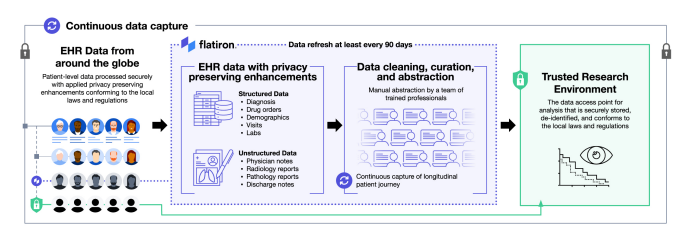
The curated data forms part of Flatiron’s international research network, which includes more than five million anonymised cancer patient records, connecting data from UK, Germany, Japan, and the United States. This secure network enables approved researchers to analyse data at scale and across borders, making possible the kinds of insights that single-country datasets cannot deliver.
For NHS organisations involved, the partnerships are cost-neutral and bring clear benefits:
- Funding to cover infrastructure and resources to establish the partnership.
- Free access to high-quality curated datasets for NHS researchers, on a regular cadence.
- The ability to use data to support patient care and service planning.
- A fair value-sharing model, with revenue returned to Trusts when data is licensed by approved researchers.
Nathan Hubbard, Chief Executive Officer at Flatiron Health, said:
Our partners are already unlocking answers to complex research questions—answers that traditional data sources can’t support. By leveraging this expanded real-world evidence, which spans from understanding standards of care and treatment patterns to informing HTA and regulatory decisions, this momentum is improving cancer care for patients worldwide.
Ensuring data security and patient privacy
Protecting patient data and privacy is at the heart of everything we do at Flatiron Health. Our data partnerships with the NHS operate under approval from the NHS Health Research Authority’s Confidentiality Advisory Group (CAG), which enables NHS organisations to provide us with access to confidential patient information without individual patient consent. This approval is essential for creating representative datasets with the clinical depth and breadth needed to support high-impact cancer research. The approval ensures that our data processes comply fully with UK law, including UK GDPR, and that the use of confidential information is justified by its value to scientific and public health research.
Flatiron Health’s data flow is secure by design. Only the minimum necessary confidential information is accessed, and only where needed, with strict controls to ensure access is limited on a need-to-know basis. All data is processed to create anonymised research-ready datasets within our Trusted Research Environment (TRE). Our security assurances include annual renewal of the NHS Data Security and Protection Toolkit (DSPT) and Cyber Essentials Plus certification, as required by the Department of Health and Social Care.
Individuals can opt out of their data being shared at any time through robust processes we put in place with our NHS partners. Through our research oversight process, access to data is assessed by an external independent panel (made up of clinicians, patients and lay representatives from across the UK) to ensure the use of data is in the patient and public interest. Flatiron also involves patients directly, through our Patient Voices Panel, to ensure transparency and accountability.
Together these measures ensure that data is handled safely, ethically, and transparently and always in the best interests of patients and the public.
Global impact: accelerating innovation in cancer research
Flatiron Health’s data network is enabling national and global research, demonstrating how real-word data contributes to a deeper understanding of cancer and accelerates innovation in oncology research. For example:
-
A comprehensive dataset representing patients receiving treatment for prostate cancer in the UK, provides insights into patient demographics, clinical characteristics, biomarker testing, treatment regimens, and mortality. This dataset fills critical gaps in existing prostate cancer data by offering a detailed view of real-world treatment and patient outcomes. The ability to harmonise this dataset with international counterparts from the US, UK, and Japan allows for a global perspective on prostate cancer management.
-
Studies using Japanese real-world data revealed differences in the age of onset for gastric and colorectal cancers compared to the US, prompting further research into tailored treatment protocols.
Professor Geoff Hall, Professor of Cancer Medicine and Digital Health and Consultant Oncologist at Leeds Teaching Hospitals NHS Trust, said:
“Flatiron’s real-world data is a powerful complement to the UK’s cancer registries, adding new clinical depth and recency that help fill critical evidence gaps. Through the combined strength of Flatiron's global oncology research network and Flatiron FORUM, we are unlocking richer insights for both local innovation and multinational research—ultimately supporting more informed clinical breakthroughs, regulatory decisions, and better outcomes for patients across the UK and worldwide.”
Benefits
By contributing cancer real-world data and evidence to Flatiron Health’s global network, the UK gains benefits that extend across research, healthcare, and society.
For life sciences research, Flatiron Health’s high-quality curated datasets provide the scale, depth and diversity needed to answer complex research questions that single-country datasets cannot. This enables more compelling regulatory (i.e. Health Technology Assessment) submissions, richer insights into the effectiveness of treatments, and faster development of innovative therapies for patients in the UK
The NHS receives financial returns from their partnerships with Flatiron Health and free access to local, curated datasets that reflect their patients’ journey of care, and international datasets, enabling clinicians, researchers and patients to take part in more ambitious and global studies.
For patients, the benefits include more opportunities to be involved in clinical trials, better evidence to support diagnosis and treatment, and improved quality of life through more tailored care pathways. Importantly, curated datasets include data from under-represented groups, helping to reduce inequalities and ensuring research reflects the diversity of patients living with cancer.
Flatiron Health’s partnerships are strengthening the wider life sciences economy by attracting investments, supporting international research, and building capacity across NHS partners. By ensuring value flows back to NHS organisations and enabling innovation in drug development and clinical practice, these collaborations contribute to both improved patient outcomes and economic growth.
Our approach is rooted in partnership, transparency, and respect for patient choice. Data is always used responsibly, for projects that deliver tangible benefits to patients and society.
Conclusion
UK health data, when curated securely and connected to international datasets, is a powerful driver of global cancer research. Through our partnerships with NHS Trusts, Flatiron Health ensures that this data not only drives innovation worldwide but also strengthens the UK life sciences economy and brings meaningful value back to patients and the NHS.
By enabling the UK to play a leading role in advancing real-world evidence, Flatiron Health UK is helping to turn patient experiences into better evidence, better treatments, and ultimately, better outcomes for people with cancer.
Interested to learn more?
Contact us today to explore how we can help transform your data.
References
1. Cancer Research UK
https://www.cancerresearchuk.org/health-professional/cancer-statistics/incidence#heading-Zero (Accessed May 2025)
2. Cancer Research UK
https://news.cancerresearchuk.org/2025/06/03/cancer-in-the-uk-50-years-death-rates-fall-by-a-fifth/
3. Tackling the lack of diversity in cancer research
https://pmc.ncbi.nlm.nih.gov/articles/PMC10499025/
4. Challenges and best practices for digital unstructured data enrichment in health research: A systematic narrative review
https://pmc.ncbi.nlm.nih.gov/articles/PMC10566734/
5. Real-World Data Sources for Oncology in Five Major European Countries: A Targeted Literature Review
6. Characterisation of oncology EHR-derived real-world data in the UK, Germany, and Japan
www.sciencedirect.com/science/article/pii/S2949820125000025
7. Real-world insights into prostate cancer management using EHR-derived data from the UK:
8. Early-Onset Gastric and Colorectal Cancer in Japan and the US
https://resources.flatiron.com/publications/early-onset-gastric-and-colorectal-cancer-in-japan-and-the-us